

J.G. Ballard and the Parenthetical Afterthought
I have a confession to make: I don’t like reading J.G. Ballard.
I know, I know, this is heresy to anyone in the world of SF, and even literature more generally.
So let me offer this caveat: I love the bizarre reality of his books. I love the psychedelic psychosis his characters descend into. I love that every ending is always tainted by a sense of uneasy ambiguity. I love the rough and ugly and barbaric unconscious impulses that he exposes, and that drive us all, but especially the privileged upper-middle class he always writes about.
What I don’t like is actually reading his books. Passing my eyes over the words themselves feels like dragging my knuckles over rough stone.
For a long time, I couldn’t understand why, and I explained it simply by saying that I don’t like the way he puts words together. But I’m happy to report that after way too much thinking about the problem, I’ve figured it out.
Enter the Parenthetical Afterthought
A parenthetical afterthought is a grammatical construction where the author makes a simple statement, and then adds some extra information afterwards, usually on a whim, and often breaking the rules of “proper” grammar. See, I just did it right there.
The author constructs a simple statement, and then adds some extra information afterwards, usually on a whim, and often breaking the rules of “proper” grammar.
Okay, yes, very meta, but what about in a real book?
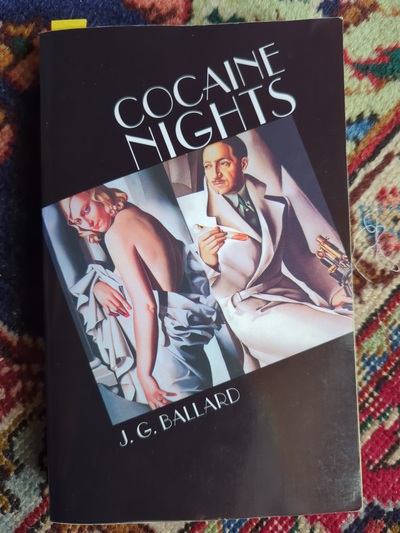
Here’s an example from Cocaine Nights by J.G. Ballard:
“The mountains had withdrawn from the sea, keeping their distance a mile inland.” (p. 15)
The parenthetical afterthought is the bit after the comma:
The mountains had withdrawn from the sea, keeping their distance a mile inland.
The ungrammatical bit about this is that it uses a comma in place of a more accurate grammatical form that would more clearly indicate how the two halves are related. The way Ballard has done it here, the geographical position of the mountains is just kind of plonked in at the end of the sentence, as if he couldn’t be bothered to figure out how to phrase the sentence correctly.
One of the interesting things
about this phrasing is how
little work you have to do to
get it into a “correct”
grammatical form.The other thing
is how consistently
Ballard uses this kind of
sentence. I’ve found examples
him using it regularly in his
most recent work before his
death in the 2010s, but also in
The Drowned World, which came
out in 1962!
For example, you’d have to do something like:
The mountains, having withdrawn from the sea, were keeping their distance a mile inland.
My version is also a perfect example of a parenthetical clause, as opposed to an afterthought. A parenthetical clause splits a sentence in half and adds the extra information by inserting it between two commas. It’s parenthetical because you could remove it from the sentence without altering the main statement.
The mountains were keeping their distance a mile inland.
Parenthetical clauses are a perfectly normal phenomenon in English, and no grammarian would ever argue that they’re bad grammar.
Similarly, you can pull a parenthetical afterthought off the sentence, and the main statement remains the same.
The mountains had withdrawn from the sea, keeping their distance a mile inland.
Becomes:
The mountains had withdrawn from the sea.
An Unholy Mess
Kurt Vonnegut once quipped that the semi-colon is for pretentious intellectuals, and all any real writer needs is the comma. Ahem. Much as I love the works of the noble Mr Vonnegut, he couldn’t be more wrong.
The comma’s function is to signify that two ideas are not only directly related, but also belong together in the same sentence. There is no limit to the number of meaning fragments that can be joined together using commas, and there are examples of grammatically correct sentences that are more than a page long.
However, this requires incredible artistry, and when the comma is used incautiously, the author inevitably ends up creating a lumbering Frankenstein of a sentence. Here’s an example from Ballard’s The Drowned World.
“Confined to his cabin for up to a week on end, he steadily retreated into his private world, going through his old notebooks and running his fingers, like a blind man reading Braille, across the glass display cases with their few mounted butterflies and giant moths.” (p.47)
Ignoring the nonsensical
assertion that a blind person
can read glass like
Braille,Glass is
smooth and Braille only
works because it’s not.
this sentence is
the perfect argument for the
value of the semi-colon.
Here, the commas are stretched beyond their job description, and perform different functions depending on where they are in the sentence, which is confusing for the reader. It would have been much simpler if Ballard had put a tiny bit more effort into his punctuation.
Specifically, if he’d put a semi-colon instead of the comma after “private world” the sentence would be much easier to parse.
Confined to his cabin for up to a week on end, he steadily retreated into his private world; going through his old notebooks and running his fingers, like a blind man reading Braille, across the glass display cases with their few mounted butterflies and giant moths.
This illustrates the function of a semi-colon; to indicate that the two thoughts are closely related, but nevertheless separate. Technically, they should be expressed in separate sentences, but they’re so close that it just kind of feels better to stick them together.
But really, Ballard’s problem here isn’t the punctuation, it’s the entire sentence; the ideas are poorly structured, and the resulting mess is ugly and doesn’t make sense.
Here’s what I would do instead:
He’d been confined to his cabin for a week at a time, and was steadily retreating into his private world. When he wasn’t going through his old notebooks, he was running his fingers over the glass museum cases—as if there was some secret to be read in the smooth glass—and staring blindly down at the few butterflies and moths that had been mounted there.
Poetical Style
Not every use of the parenthetical afterthought is as ugly as that example; when used artfully, they can be quite lovely.
This from Ballard:
“Steiner sat forward over the fire, wiping grease from his hands and casually ignoring the rifle which he had propped against the diving board. The three nomads, their women crouched behind them, were nervous as birds. Their sharp eyes searched the darkness, unsettled by the slightest movement.” (Hello America, p.61)
This from Mick Herron:
“Commuters washed round him like water round a rock, their irritation evident in clicking of tongues and expulsions of breath.” (Slow Horses, p.1)
And this from Ernest Hemingway:
“Robert Jordan went into the cave and up to where Maria was standing. She watched him come toward her, her eyes bright, the blush again on her cheeks and throat.” (For Whom the Bell Tolls, p.92)
I was surprised to find the
Hemingway example, if I’m
honest. I’d assumed that this
was a modern phenomenon and so
wouldn’t be found in anything
written before 1960-ish.For Whom The
Bell Tolls was published in
1940.
But then I found
something similar from twenty
years earlier, in 1920.
This from Joseph Conrad:
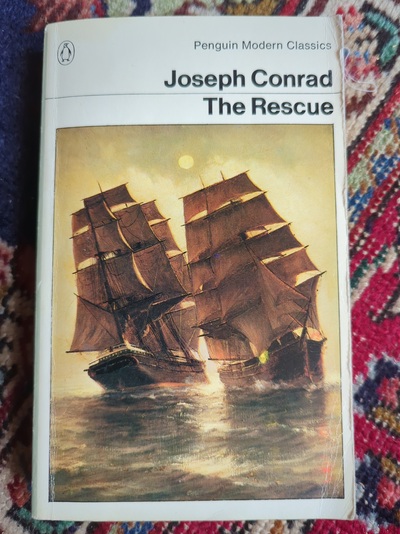
“D’Alcacer passed on, raising his cap to Mrs Travers, and went down the ship’s side into the boat. Jörgensen had vanished in his own manner like an exorcised ghost, and Lindgard, stepping back, left husband and wife face to face.” (The Rescue, p.289)
Now, technically, this is a totally kosher use of parentheticals because you can remove them from the sentence without affecting the meaning.
D’Alcacer passed on and went down the ship’s side into the boat.
Their function is the important thing, however. Conrad uses them in a descriptive, adverbial mode, meaning that they’re adding information about how an action is being performed. They can also be used in an adjectival mode, in which they describe what an object looks like:
“Three figures, two large, one smaller, but only one of them was in focus, was more than an outline or a shimmer.” (The Graveyard Book, Neil Gaiman, p.15)
When a parenthetical is used properly, as Conrad has done, it adds a bit of description about and object or how an action was performed, but without it the sentence also feels complete and robust. The parenthetical clause adds depth and perspective, and feels intentional and helpful; like it’s been done with care and consideration for the reader’s understanding.
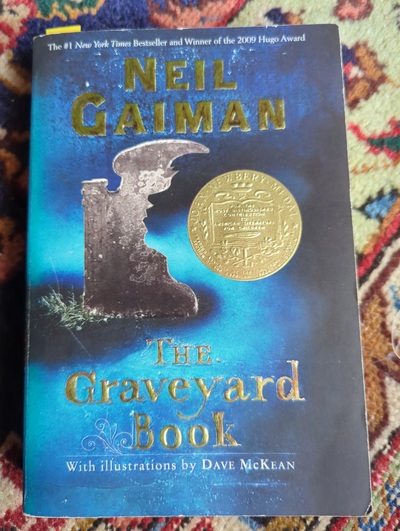
When it’s used like Gaiman has done, it can make an unholy grammatical mess of what would otherwise have been a simple sentence:
Only one of the three figures was in focus, and the two larger forms were little more than an outline or a shimmer.
Now, please don’t misunderestimate me, I like Gaiman’s construction, but that doesn’t mean it’s not a bunch of grammatical gobbledegook.
Which is kind of my point. When used artfully and with care, the parenthetical afterthought can create a poetical rhythm out of an otherwise dry sentence.
“You could see the abandoned funeral chapel, iron doors padlocked, ivy on the sides of the spire, a small tree growing out of the guttering at roof level.” (The Graveyard Book, p.12)
However, most of the time, they aren’t used this way.
Cheap, Lazy and Incomplete
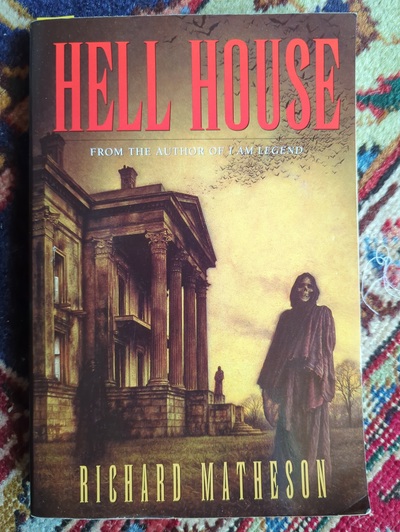
Richard Matheson, for example, uses parenthetical afterthoughts continuously in Hell House and the book suffers because of it. The prose feels cheap, lazy, and incomplete, as if it was written as quickly as possible by a jaded pulp writer twenty years into a sixty-year career pumping out an endless stream of horror stories.
“Across from where they stood was a mammoth fireplace, its mantel constructed of antique carved stone.” (p.34)
And again:
“The seats were custom-made, upholstered with wine-red velvet.” (p.35)
If you strip off the afterthoughts, you’re left with:
Across from where they stood was a mammoth fireplace.
and:
The seats were custom made.
Technically, these are totally kosher simple sentences, but they also feel like cardboard without the afterthought hanging off the end. And even with them, it just feels like putting lipstick on a pig.
An Intentional Pig
What doesn’t make sense to me is that the grammatically correct forms of both of these sentences are not only more complete and more pleasurable to read, they also require almost no extra effort to write.
The seats were custom-made and upholstered with wine-red velvet.
And:
Across from where they stood was a mammoth fireplace with a mantel carved from antique stone.
The consistency with which Matheson uses afterthoughts suggests that they’re an aesthetic choice; literally the entire book is written this way. Every page is littered with these artless half-statements, each with a bit of descriptive junk tacked onto the end.
Here’s an example of what I mean:
“Its ceiling was divided into a series of elaborately carved panels, its floor polished travertine. Its walls were paneled to a height of twelve feet, stone blocked above. In the center of the wall was a giant fireplace, its gothic mantelpiece reaching to the ceiling. Spaced at intervals above the length of the forty-foot table in the center of the hall hung four immense sanctuary lamps, wired for electricity. Thirty chairs stood around the table, all of them constructed of antique walnut with wine-red velvet upholstery.” (p.51)
This paragraph certainly has a sense of rhythm, but that rhythm is formulaic, and the whole thing just feels lazy and cheap. After 50 pages, the prose becomes a mush of syllables smooshed together in a bland blob of who-gives-a-fuck.
Cautionary Tale
This feeling is, I think, what people object to when they talk about pulp fiction, or say that a book feels commercial. Either the writing is 200 pages of completely artless descriptive statements, or, if it does have a bit of style, it relies too heavily on the lazy, formulaic repetition of a single grammatical gimmick.
Like I said, I like parenthetical afterthoughts when they’re used well. The problem is that doing it badly is easy; so easy that it can hijack your entire writing style and ruin what would otherwise be a good story…
Bibliography
The Rescue, Joseph Conrad, 1920/1978, Penguin Books Ltd.
The Drowned World, J.G. Ballard, 1962/2012, Liveright Publishing Corporation
Hello America, J.G. Ballard, 1981/1988, Carrol & Graff Publishers Inc.
Cocaine Nights, J.G. Ballard, 1996, Counterpoint Press
The Graveyard Book, Neil Gaiman, 2008, Harper
For Whom the Bell Tolls, Ernest Hemingway, 1940/1995, Scribner Paperback Fiction
Slow Horses, Mick Herron, 2010, Soho Crime
Hell House, Richard Matheson, 1971/1999, Tom Doherty Associates (TOR)